
Updated: June 2026
Silver on the high seas
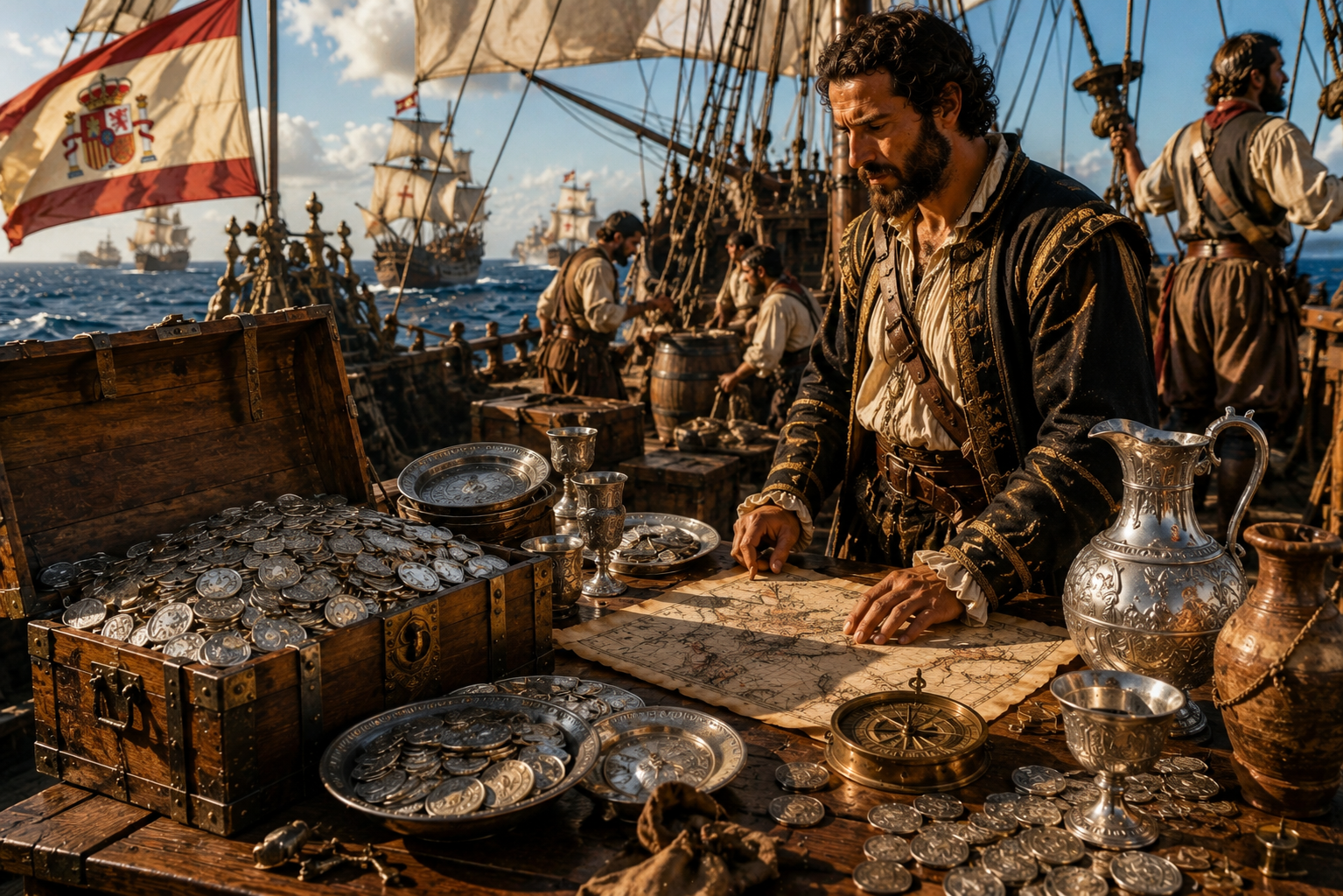
In the age of exploration, silver crossed the world’s oceans. Spanish galleons carried it home by the ton, “pieces of eight” became a global currency, and on long voyages sailors trusted silver to help keep their water fresh. Silver was the money that moved the world.
This guide covers silver on the high seas: the Spanish treasure fleets, pieces of eight, and why sailors carried silver with them on long voyages.
When Europe set out to explore the world, silver went with it — and often it was the whole reason for the voyage.
Here are the questions people ask most about silver’s seafaring chapter. For the full sweep, see the story of silver.
UK-made colloidal silver, in dark glass
Double-purified water — reverse osmosis, then distilled — with real silver. Made in the UK.
What was a piece of eight?
A piece of eight was the Spanish eight-reales silver coin — also called the Spanish dollar — and it became one of the world’s first global currencies.
Struck from New World silver, it was trusted across Europe, the Americas and Asia, and it later gave its name to the dollar and the peso. It is the coin of pirate legend, and of Treasure Island.
Why was it called a “piece of eight”?
Because the coin was worth eight reales, and could be physically cut into eight pieces to make smaller change.
Those cut sections were known as “bits” — the same word that survives in the old American phrase “two bits” for a quarter dollar.
What were the Spanish treasure fleets?
They were armed convoys that carried silver from the Americas back to Spain, twice a year, for more than two centuries.
Known as the “plate fleets”, after plata, the Spanish word for silver, they gathered the riches of Peru and Mexico and ran them across the Atlantic.
- From the mines — tons of silver dug from Peru and Mexico.
- Across the Atlantic — carried home in armed treasure fleets.
- Around the world — spent as coin from Europe to Asia.
Why did sailors put silver coins in their water?
Sailors, and later pioneers and settlers, were known to drop a silver coin into a water cask or a jug of milk, trusting it to help keep the contents fresh on a long journey.
It was an old habit rather than a tested method. We make no health claims about it, and our colloidal silver is sold for external use only.
What happened to the 1715 treasure fleet?
In 1715, a Spanish treasure fleet was wrecked by a hurricane off Florida, scattering its silver along the coast.
Coins from that fleet still wash up on what is now called the Treasure Coast, more than three centuries later, with fresh hoards recovered as recently as last year.
Silver crossed oceans as money, and travelled in water casks as a trusted companion on the longest journeys.
We keep that long association going in a smaller way — carefully made colloidal silver, produced in the UK and bottled in dark glass.
Buy more, save more
Build your own pack and save up to 15%, or pick a ready-made bundle.
Secure checkout · Made in the UK
Why buy from Health is a Choice
We make our colloidal silver in the UK, the way we would want it for our own family. We don’t purify our water once — we do it twice.
It is first cleaned by reverse osmosis, then distilled on top of that, before we suspend real silver in it and bottle it in dark glass — never plastic.
- Made and bottled in the UK
- Bottled in dark glass, never plastic
- Double-purified water: reverse osmosis, then distilled
- Available in 10, 100 and 200 ppm
- 100ml dropper, 100ml spray and 500ml refill
- Free Royal Mail Tracked 48 on every order
Related guides
- The story of silver: from ancient vessels to modern day
- Silver in the ancient world: coins, cups and kings
- Silver in modern life: technology and materials
- Colloidal silver: the complete UK guide
Made in the UK · Dark glass, never plastic · Free Royal Mail Tracked 48
Last updated: June 2026
This article is for general information only and is not medical advice. We make no medical claims. If you have a health concern, please speak to your GP or pharmacist.