
Updated: June 2026
Silver in the ancient world
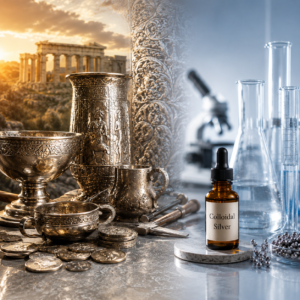
Silver has been prized for thousands of years. In the ancient world it became money, fine tableware, and a way to carry water on long journeys. From the first Lydian coins to the kings of Persia, its early story runs through coins, cups and kings.
This guide covers silver in the ancient world: the very first silver coins, why Greeks and Romans prized silver cups, and what the archaeology shows.
Long before anyone spoke of colloidal silver, the metal itself was already woven through the ancient world.
Here are the questions people most often ask about it. For the whole arc, see the story of silver.
UK-made colloidal silver, in dark glass
Double-purified water — reverse osmosis, then distilled — with real silver. Made in the UK.
Who made the first silver coins?
The first silver coins were struck in Lydia, in what is now Turkey, around the seventh century BC.
The historian Herodotus credits the Lydians with the first gold and silver coinage, and their King Croesus with striking coins of pure silver.
From there, silver money spread across the ancient world — the Greek drachma, and later the Roman denarius, which was modelled on it.
What did people use silver for in the ancient world?
In the ancient world, silver was used as money, as fine tableware, and as vessels for carrying water and wine.
- Money — coins that crossed borders, from the Lydian stater to the Roman denarius.
- Tableware — cups, plates and jugs for those who could afford them.
- Carrying water — vessels used to store and move water on long journeys.
Did ancient people store water in silver vessels?
Yes. The Greeks and Romans stored water and wine in silver vessels, which they believed helped keep the contents fresh.
The most striking example comes from Herodotus, who records that the kings of Persia would drink only boiled water carried with them in silver vessels, on a long train of mule wagons, even on campaign.
Did storing water in silver actually keep it fresh?
The ancients certainly believed it did, and the habit lasted for centuries.
Modern researchers have since studied water kept in silver containers as well. We don’t draw any health conclusions from that — we make no medical claims, and our colloidal silver is sold for external use only.
Why was silver so valuable in the ancient world?
Beyond money, silver meant power.
The silver mines at Laurion helped fund the Athenian fleet that turned back Persia at Salamis in 480 BC. Silver bought ships, paid soldiers and built empires.
What ties it all together is simple: people have valued silver, and trusted it, for a very long time.
We make our own small contribution to that long story — carefully made colloidal silver, produced in the UK and bottled in dark glass. The history is theirs; the craft is ours.
Buy more, save more
Build your own pack and save up to 15%, or pick a ready-made bundle.
Secure checkout · Made in the UK
Why buy from Health is a Choice
We make our colloidal silver in the UK, the way we would want it for our own family. We don’t purify our water once — we do it twice.
It is first cleaned by reverse osmosis, then distilled on top of that, before we suspend real silver in it and bottle it in dark glass — never plastic.
- Made and bottled in the UK
- Bottled in dark glass, never plastic
- Double-purified water: reverse osmosis, then distilled
- Available in 10, 100 and 200 ppm
- 100ml dropper, 100ml spray and 500ml refill
- Free Royal Mail Tracked 48 on every order
Related guides
- The story of silver: from ancient vessels to modern day
- Alexander the Great and silver
- Silver on the high seas: explorers and long voyages
- Colloidal silver: the complete UK guide
Made in the UK · Dark glass, never plastic · Free Royal Mail Tracked 48
Last updated: June 2026
This article is for general information only and is not medical advice. We make no medical claims. If you have a health concern, please speak to your GP or pharmacist.